A restaurant owner in Karachi searched Google for "restaurants near Gulshan-e-Iqbal" recently. Her competitor — a smaller place with a simpler menu — appeared at the top. Her own restaurant, open for eight years, was nowhere on the first page.
She was spending on Instagram ads. Her competitor was not spending on any ads at all.
The difference was not budget. It was not even the quality of the food. It was the work the competitor had quietly done to make sure Google understood who they were, where they were, and why people trusted them. All of it was free. None of it was complicated. And most of her competitors were not doing it properly.
This guide covers exactly what that work looks like — for any local business, in any country, in 2026.
What "Page One" Actually Looks Like in 2026
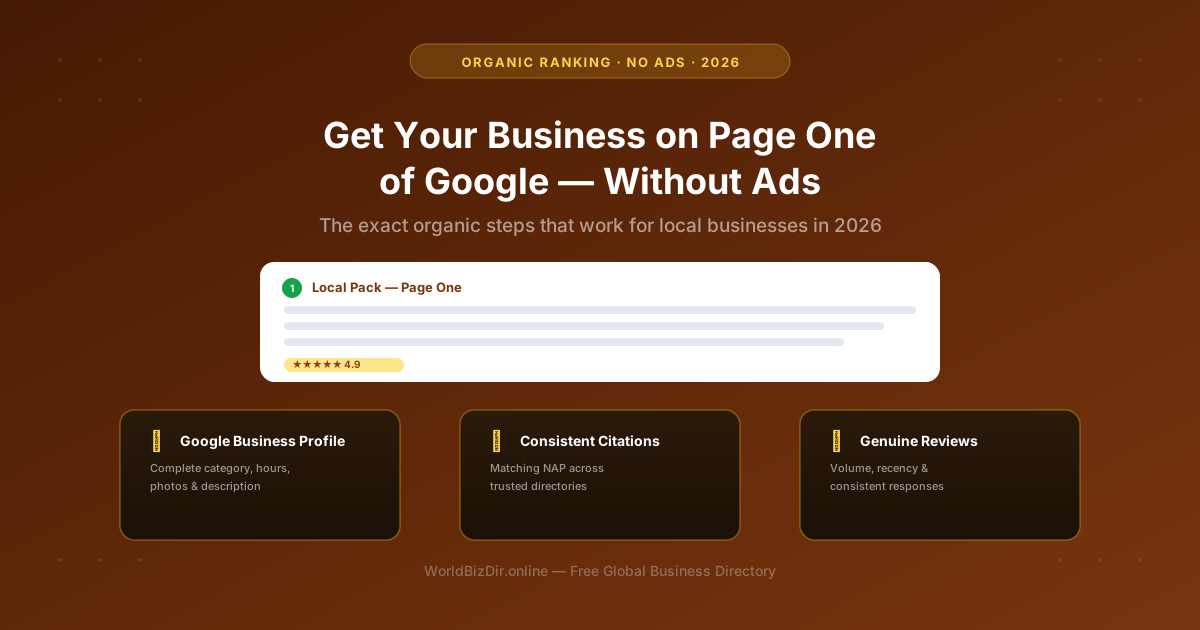
Before talking about how to get there, it helps to understand what you are actually trying to get into. Google's first page for local business searches is not a single thing. It has several distinct sections, and they work differently.
For a local business, the local pack is where you want to be first. It appears before organic results, gets high click-through rates, and does not require ranking a website at all — it is driven entirely by your Google Business Profile and local signals. Both matter, but for most local businesses, local pack visibility is the faster and higher-priority win.
Step 1: Your Google Business Profile Comes First
If you have not claimed your Google Business Profile, stop reading this and do that first. Go to Google, search your business name, and look for the "Claim this business" option. If you have never set one up, create one at business.google.com. It is free and it is the single most important action for local search visibility.
Once claimed, filling it out properly is what most businesses get wrong. They add a name, a phone number, and a rough address — and then leave it at that. That is not enough to rank. Here is what complete actually means:
A Google Business Profile that is fully completed and regularly updated will outrank an incomplete profile from a competitor — even a competitor who has been operating longer and has a fancier website.
Step 2: Build Consistent Citations Across Directories
A citation is any mention of your business name, address, and phone number on another website. Google collects these citations from across the web and uses them to verify that your business information is accurate and that you are a legitimate, established operation.
The logic is straightforward: if your business name, address, and phone appear identically on 20 reputable platforms, Google has high confidence in that information. If your details are scattered, inconsistent, or missing from most platforms, Google has much less to work with.
What matters most is consistency. Your business name must be exactly the same everywhere — not "Khan's Electricals" on one platform and "Khan Electrical Services" on another. Your phone number format must match. Your address must use the same abbreviations and spelling throughout. Even small variations create conflicting signals that weaken your local authority.
Start with the highest-authority directories in your country and industry, then expand. Listing your business on WorldBizDir — which covers 195 countries and 50+ industry categories — contributes to your citation network and provides a backlink from a globally indexed directory. Then add country-specific directories, industry directories, and local platforms.
Aim for 15 to 20 quality citations before worrying about quantity. Fifteen consistent, accurate listings on reputable platforms do more for your ranking than 100 inconsistent listings on obscure directories.
Step 3: Your Website Needs to Say Where You Are and What You Do
This sounds obvious. Surprisingly few business websites do it well.
Google reads your website to understand what your business is about and who it serves. If your homepage has a beautiful design, a hero image, and a vague tagline like "Quality service you can trust" — Google does not know what you do, where you do it, or for whom. It cannot rank you for specific local searches because it does not have the information to do so.
Your homepage should clearly state your business type, your primary location, and the core services you offer — in plain text, in the first few paragraphs. If you serve specific cities, suburbs, or regions, name them explicitly on your services or about page. A plumber in Lahore whose website mentions DHA, Gulberg, Model Town, and Johar Town gives Google geographic context to match their listing against neighbourhood-specific searches. A plumber whose website mentions none of these places does not.
Your page titles and meta descriptions matter too. Each page on your website should have a unique title tag that includes your service and location — for example: "Commercial Electrician in Karachi | [Business Name]". This is one of the clearest on-page signals you send to Google about what a page is about.
You do not need to hire an expensive developer for any of this. Most website platforms — WordPress, Wix, Squarespace, Shopify — allow you to edit page titles and add location-specific content yourself. The content itself matters far more than the technology it sits on.
Step 4: Reviews Are Not Optional
Look at the businesses sitting at the top of local search results in any competitive category. Almost without exception, they have more reviews than those below them — and those reviews are more recent.
Google treats reviews as a direct signal of a business's reputation and activity. A business with 150 reviews and a 4.5 average tells Google two things: a lot of customers have used this business, and most of them were satisfied enough to say so publicly. That is a trust signal that no amount of website optimisation can fully substitute for.
Getting reviews requires asking for them. Most satisfied customers do not leave reviews spontaneously — they go home, carry on with their day, and forget. A simple, direct ask at the right moment makes the difference. After completing a job, finishing a meal, or closing a sale, ask the customer directly: "Would you mind leaving us a quick review on Google? It helps other people find us." Most people who have had a good experience are happy to do it when asked.
Respond to every review — positive and negative alike. A business that responds professionally to a critical review demonstrates that it takes customer feedback seriously and is actively engaged. Google notices this. So do potential customers reading the reviews before choosing who to contact.
Do not offer incentives for reviews. Google's guidelines prohibit it, and fake or incentivised reviews can result in your listing being suspended or filtered. Genuine reviews from real customers, asked for at the right moment, are worth far more than manufactured ones.
Step 5: Get Other Websites to Link to You
Backlinks — links from other websites pointing to yours — remain one of Google's most important ranking signals for organic website results. For local businesses, you do not need hundreds of them. A handful of quality, relevant links from credible sources does more than dozens of links from obscure or irrelevant websites. The most practical sources for local businesses:
Never buy bulk backlinks from services offering "1,000 links for $50." Google identifies these patterns easily, and the penalty — a significant drop in rankings or removal from search results — is not worth whatever short-term benefit the links might provide.
The Part Nobody Wants to Hear
Every step above is free, or close to it. None of them are technically complex. The reason most local businesses are not on page one of Google has nothing to do with budget and everything to do with consistency over time.
A fully completed Google Business Profile that goes unupdated for two years loses ground to a competitor who updates theirs monthly. A business that collected 30 reviews last year and has not collected any since is being overtaken by the competitor who asked three customers this week. Citations that were accurate when you set them up five years ago but now show an old phone number are actively working against you.
Google's local algorithm rewards businesses that demonstrate they are current, active, and trustworthy — not just businesses that did the right things once and stopped. The advantage goes to the businesses that treat their online presence as something they maintain rather than something they set up.
None of this requires daily attention. A monthly review of your Google Business Profile, a habit of asking customers for reviews, and periodic checks that your directory information is accurate — that is enough to compound significant ranking improvements over six to twelve months.
That is what the restaurant in Karachi's competitor was doing. Nothing extraordinary. Just consistent, accurate, ongoing attention to the basics — while everyone else was either ignoring it or trying to shortcut it.
Building consistent citations across trusted directories is one of the fastest, free ways to strengthen the signals Google checks first.
🌍 Add Your Free Listing on WorldBizDir