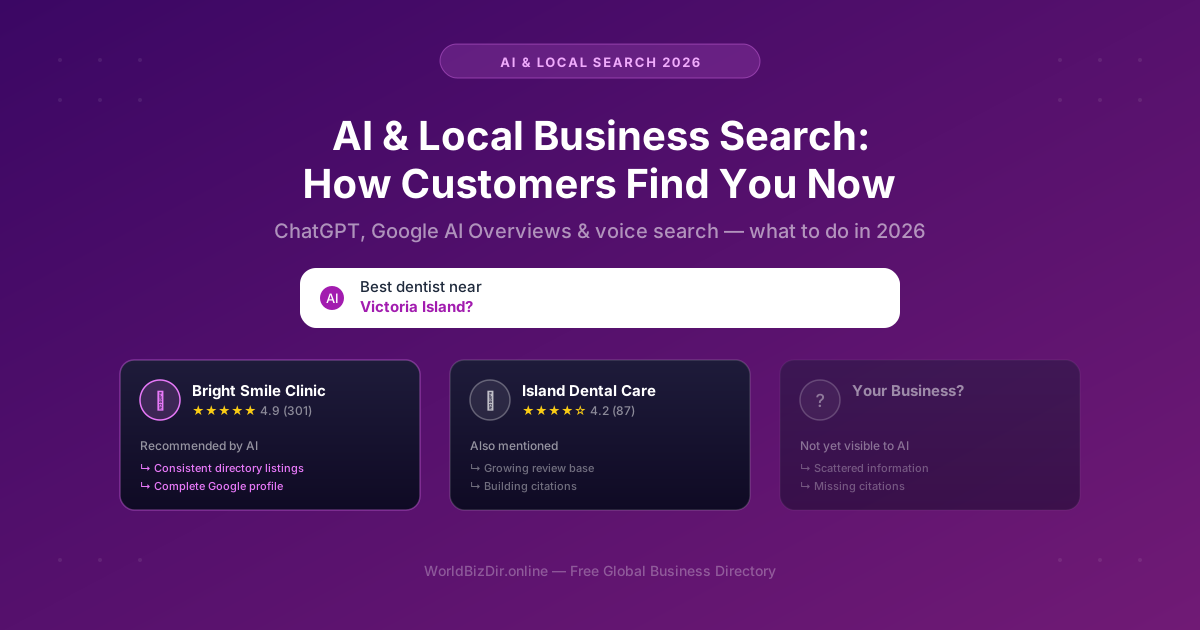
A customer in Lagos types into ChatGPT: "What is a good dentist near Victoria Island?" A customer in Karachi asks their phone: "Hey Siri, find me a restaurant open right now." A customer in London opens Google, types "plumber near me," and sees an AI-generated summary before a single website link.
These are not future scenarios. They are happening right now, thousands of times every minute, across the world. And in each case, the same question applies to your business: does it show up?
AI has entered local business search — not dramatically, not all at once, but steadily and in ways that matter for any business that depends on customers finding it online. This article explains what is actually happening, why it matters, and what to do about it.
What Has Actually Changed
Until a few years ago, the path from "customer has a need" to "customer finds a business" was fairly predictable. They typed something into Google, Google returned a list of links, they clicked one. That was largely it.
That path still exists, but several new ones have appeared alongside it. People now ask ChatGPT or similar tools for recommendations before they ever open a search engine. They ask Alexa, Siri, or Google Assistant out loud and receive a spoken answer — often just one option, not a page of results. And when they do use Google, an AI-generated overview often summarises the answer before any links appear at all.
What makes this meaningful for local businesses is not the technology itself — it is where that technology gets its information. AI tools do not know things independently. They read the web, process it, and surface what they find most credible. Which means the businesses they recommend are the ones with clear, consistent, well-distributed information across the internet.
If your business information is scattered, outdated, or missing from key platforms, AI tools simply skip you — not because they are biased against you, but because they cannot find enough consistent data to confidently recommend you.
How AI Tools Find and Recommend Businesses
This is where a lot of business owners get confused, so it is worth being specific about how each of the major AI surfaces actually works:
ChatGPT & AI Chat Tools
AI chat tools recommend businesses using information they were trained on — directories, review sites, and websites. Consistent, accurate data across trusted platforms makes a business more likely to be surfaced.
Google AI Overviews
AI-generated summaries now appear above traditional search results for many local queries, often naming specific businesses pulled from Google Business Profiles and review platforms.
Voice Assistants
Siri, Alexa, and Google Assistant read structured data — mainly Google Business Profile — to answer spoken location queries like "find me a pizza place near me."
A business that appears on its own website, on Google Business Profile, on reputable directory sites, and has genuine customer reviews creates a dense network of consistent signals. An AI reading the web sees that business mentioned in multiple trusted places and treats it as credible.
A business that exists only on one platform, has outdated contact details, or has almost no third-party mentions is effectively invisible to these tools — there is simply not enough data for the AI to confidently recommend it.
This is not fundamentally different from how traditional search has always worked — credibility and consistency have always mattered. But AI search makes the gap between a well-established online presence and a minimal one more consequential, because AI tools often return just one or two recommendations rather than a full page of results.
Google AI Overviews and Local Search
Google's AI Overviews — the generated summaries now appearing at the top of many search results pages — deserve specific attention for local business owners.
When someone searches "best cafes in Nairobi" or "accountants in Islamabad," Google increasingly shows an AI-generated summary before the traditional list of links. That summary might mention two or three specific businesses by name, or describe what to look for without naming anyone. Either way, the businesses included receive exposure that appears before any organic or paid result on the page.
How does Google decide what goes into these summaries? The same factors that have always driven local search rankings: relevance, proximity, and prominence. There is no special trick to ranking in AI Overviews — the practical implication is that local SEO fundamentals now matter even more, because the payoff is potential inclusion in the AI-generated answer most users see first.
Voice Assistants Are Still Reading the Same Data
When someone asks Siri "find me a pizza place near me" or asks Google Assistant "what gyms are open right now," those assistants pull from structured data — primarily Google Business Profile for location-based queries. The hours, address, phone number, and category listed on a business's Google profile are exactly what voice assistants use to return spoken answers.
A business with incomplete or incorrect hours listed on its Google Business Profile will not show up in "open now" voice queries. A business listed in the wrong category will not appear for relevant searches. These are not obscure technical details — they are the basic information fields that determine whether a voice assistant can confidently recommend your business at all.
The same logic extends to directory listings. Voice assistants increasingly cross-reference multiple data sources, and consistency across those sources — the same name, address, phone number, and category everywhere — reinforces the confidence an AI needs to make a recommendation.
What Small Business Owners Should Do Right Now
None of what follows requires a large budget or technical expertise. What it requires is attention to detail and consistency — which are free.
Audit Your Existing Business Information
Search for your own business on Google and on every directory you are listed on. Check that your business name, address, and phone number are identical everywhere. Even small differences — an abbreviated street name, an old phone number — create conflicting signals that AI tools pick up on.
Complete Your Google Business Profile Properly
This remains the single most important thing a local business can do for both traditional and AI-driven search. Fill in every field: business category, description, opening hours, photos, and attributes. Businesses with fully completed profiles appear more credible to both Google’s algorithm and the AI systems built on top of it.
Get Listed on Reputable Directories — and Keep Them Updated
Business directories create the citation network that AI tools read when assessing a business's credibility. Being listed on multiple trusted platforms, with consistent information across all of them, is one of the clearest signals of a legitimate, established business. WorldBizDir, for example, covers 50+ business categories across 195 countries, contributing directly to that citation network.
Collect and Respond to Genuine Reviews
Reviews appear in AI Overviews, in voice search results, and in the data AI tools use to assess business quality. Ask satisfied customers to leave reviews on your Google Business Profile, and respond to every review — positive and critical alike. An active review profile signals that a business is current and engaged, not dormant.
Make Sure Your Website Describes What You Actually Do
AI tools that browse the web read your website. If your homepage has vague text that does not clearly state what you do, where you operate, and who you serve, you are missing an opportunity. A clear, plainly written "About" page and service descriptions are more useful for AI discoverability than elaborate marketing language.
The Bottom Line
AI has not replaced local search — it has expanded it. The same signals that helped a business rank well on Google five years ago still matter: accurate information, consistent citations, genuine reviews, and a clear description of what the business offers and where.
What AI has changed is the consequence of getting those things wrong. When search returned a page of ten links, a business could rank eighth and still get some traffic. When an AI tool returns one or two recommendations, businesses outside that narrow selection get nothing.
That makes getting the fundamentals right more important in 2026 than it has ever been. Not more complicated — just more important.
If your business is not yet listed in reputable online directories, that is the most immediate step you can take today.
🌍 Add Your Free Listing on WorldBizDir