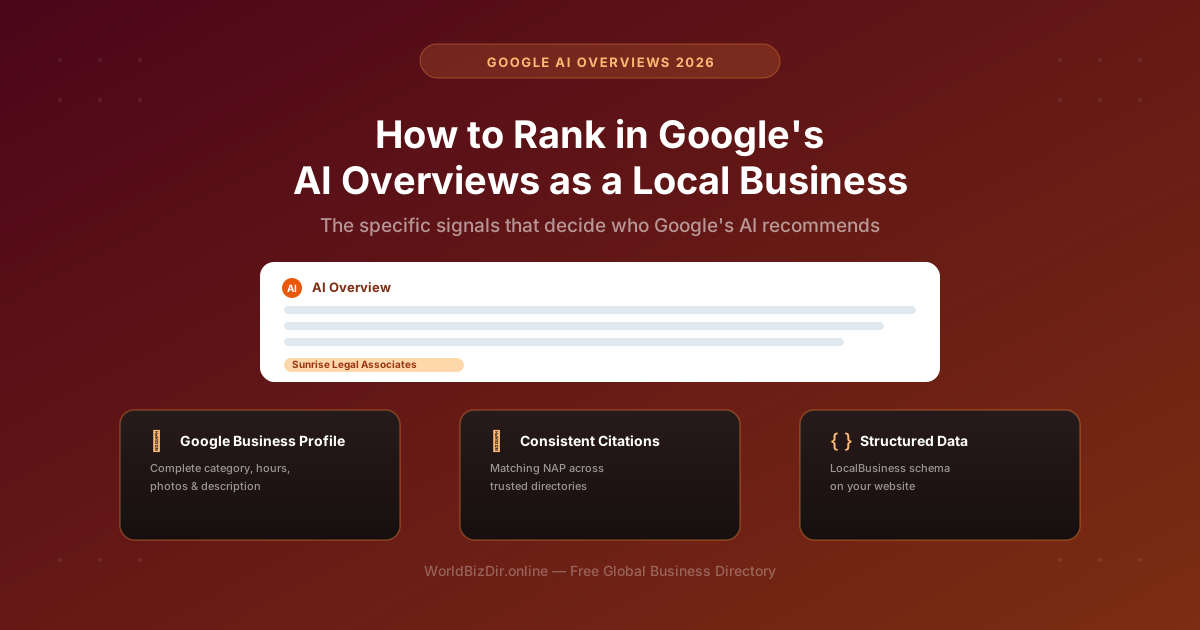
Search "best law firms in Nairobi" on Google today. Before you see a single website link, there is a good chance you will see a paragraph — or several — generated by Google's AI, summarising what to look for, sometimes naming specific firms, and pulling details from across the web into one tidy block at the top of the page.
That block is a Google AI Overview. It did not exist three years ago. Today it appears for a significant and growing share of local business searches worldwide. And for the businesses that appear in it, the visibility is substantial. For those that do not, traditional search results have been pushed further down the page before a user even gets there.
This article is a practical guide for local business owners who want to understand what AI Overviews are, how they work for local searches specifically, and what actions actually improve your chances of appearing in them.
What Google AI Overviews Actually Are
Google AI Overviews — previously called Search Generative Experience, or SGE, during a long testing period — are AI-generated text summaries that appear at the top of Google search results. They are not advertisements. They are not a curated list of links. They are a synthesised response that Google's AI builds by reading multiple web sources and producing a cohesive answer.
From a user's perspective, they look like a direct answer. From a business owner's perspective, they represent a layer of Google search results that did not previously exist — one that sits above everything else on the page.
Google has been clear that AI Overviews draw from the same index it has always used — websites, structured data, business profiles, review platforms, and directories. The AI does not have secret sources. It reads what is already on the web and decides what is credible enough to surface.
That is the part that matters most for local businesses: the same signals that have always influenced local search rankings influence AI Overview inclusion. The system is not a mystery. It is the existing web, processed differently.
How They Work for Local Business Searches
Not every search triggers an AI Overview. Google uses them selectively, and local business searches fall into a few distinct patterns worth understanding.
For broad informational queries — "how to choose a dentist" or "what should I look for in a law firm" — AI Overviews tend to produce general guidance rather than naming specific businesses. These are useful for positioning your business's blog content or FAQ pages as sources Google might cite.
For specific local queries — "best restaurants in Accra" or "accountants in Islamabad" — AI Overviews behave differently. They often pull a short list of specific businesses, sometimes with brief descriptions, ratings, or location details, drawn from Google Business Profiles, directories, and review platforms.
For near-me queries on mobile — "plumber near me" or "pharmacy open now" — AI Overviews may appear alongside or instead of the traditional local pack map. The accuracy of your Google Business Profile hours, location, and category becomes critical here, because the AI is essentially answering a real-time question.
Why This Changes the Stakes for Local Businesses
Traditional search results had a predictable hierarchy. Position one got the most clicks, position two fewer, positions eight through ten very little — but every position was at least visible when the page loaded.
AI Overviews add a step before all of that. A user types a query, sees the AI-generated block, reads it, and in many cases either finds their answer there or clicks one of the sources cited within it — without scrolling down to the traditional results at all.
Studies tracking user behaviour after AI Overviews launched found that click-through rates on traditional organic results dropped for queries where an AI Overview appeared. Traditional SEO still matters — but the game now has an additional level.
For a local business competing in a city with dozens of similar competitors, being named in a Google AI Overview for a relevant local query can be the difference between a customer calling you or never knowing you exist.
What Google Actually Uses to Build AI Overviews
Google has not published a detailed technical specification for what feeds AI Overviews. But between what Google has communicated publicly and what SEO researchers have observed across thousands of examples, a clear picture has emerged.
Specific Steps to Improve Your Chances
These are not general suggestions. Each one addresses a specific signal that feeds into AI Overview generation for local business searches.
Complete Every Field in Your Google Business Profile
Fill in your primary category and every relevant secondary category. Write a business description that plainly states what you do and where. Upload recent photos and set your hours correctly, including special hours for public holidays. Profiles with completion rates above 90% consistently appear in more AI-generated results than partially filled ones.
Build Citations Across Reputable Directories
Every reputable directory listing is a corroborating data point for Google's AI. The business name, address, phone number, and category must be identical everywhere — not similar, identical. A listing on WorldBizDir, which covers 195 countries and 50+ categories, contributes to this citation network alongside your other directory listings.
Add LocalBusiness Schema Markup to Your Website
If your website has no structured data, adding LocalBusiness schema is one of the highest-value technical actions you can take. It defines your business type, name, address, phone, opening hours, and service area in a format Google reads directly. A developer can add this in under an hour.
Write Location-Specific Content on Your Website
If you serve a specific city, district, or region, say so explicitly — not just on your contact page, but in your service descriptions and about page. Mentioning the actual neighbourhoods you serve gives Google’s AI geographic context it can use when answering location-specific queries.
Respond to Customer Reviews Consistently
Review responses are indexed by Google. Responding to reviews — including critical ones, professionally and helpfully — signals that a business is active and engaged. A business with hundreds of reviews and zero responses appears less active than one with fewer reviews and consistent engagement.
Answer Common Questions on Your Website
Google’s AI frequently pulls directly from FAQ sections when generating informational overviews. If customers commonly ask about pricing, availability, or process, and those questions are answered clearly on your website, you create content Google’s AI can cite. FAQ schema strengthens this further.
The Honest Reality
There is no direct switch to flip that puts your business into a Google AI Overview. Google controls what appears there, and it changes dynamically based on the query, the user's location, and the current state of your business's online presence.
What you can control is the quality and consistency of the signals you send. A business that keeps its Google Business Profile accurate and complete, maintains consistent listings across reputable directories, collects genuine reviews, has a website that clearly describes what it does and where it operates, and uses structured data — that business is doing everything within its control to be considered.
Most competitors are not doing all of these things. Most are doing one or two and ignoring the others. That gap is where the opportunity sits.
Consolidating your citations across trusted directories is one of the fastest ways to strengthen the signals Google's AI checks first.
🌍 Add Your Free Listing on WorldBizDir